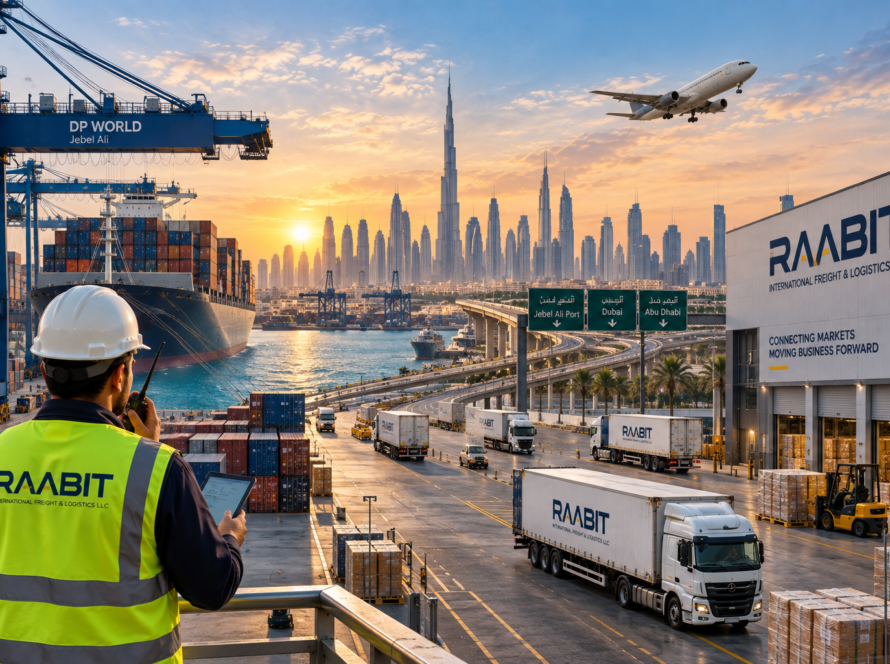

Sea, Air or Road? Understanding the right transportation method can help businesses control logistics costs, improve delivery times and keep their supply chains moving.
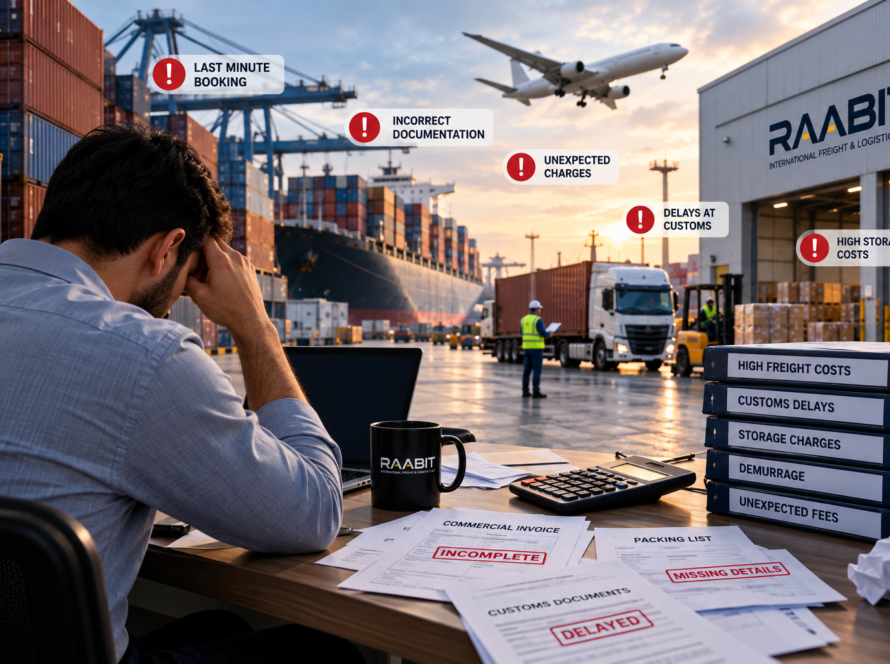
For businesses involved in international trade, transportation is one of the most important parts of the supply chain. Choosing the wrong freight method can result in higher costs, unnecessary delays and operational difficulties.
At RAABIT International Freight & Logistics LLC, we help businesses evaluate their cargo requirements and coordinate suitable transportation solutions across the UAE, GCC and international markets.
Understanding Your Shipment First
Before selecting a transportation method, several factors should be considered:
- Cargo type and quantity
- Weight and dimensions
- Origin and destination
- Required delivery date
- Budget
- Customs and documentation requirements
- Special handling requirements
There is no single transportation method that is best for every shipment. The right solution depends on what matters most for that particular movement.
Ocean Freight: Ideal for Larger Shipments
Ocean freight is one of the most widely used methods for international cargo transportation, particularly when moving large quantities of commercial goods.
Businesses can generally choose between Full Container Load (FCL) and Less than Container Load (LCL) depending on shipment volume.
FCL – Full Container Load
FCL provides a dedicated container for your shipment. It is commonly suitable for larger cargo volumes and businesses regularly importing or exporting goods.
LCL – Less than Container Load
With LCL, cargo shares container space with shipments from other customers. It can be a practical option when the shipment is not large enough to require an entire container.
Ocean freight is generally suitable when cost efficiency and cargo capacity are more important than the fastest possible transit time.
Air Freight: When Speed Is the Priority
For urgent and time-sensitive cargo, air freight can significantly reduce transportation time.
It is commonly considered for shipments where delivery schedules are critical or where the cargo’s value and urgency justify the higher transportation cost.
Air freight can be particularly useful for:
- Urgent commercial shipments
- High-value goods
- Samples and replacement parts
- Time-sensitive inventory
- Smaller international shipments
Although air freight is generally more expensive than sea freight, faster transit can sometimes prevent production delays or inventory shortages that would otherwise cost a business considerably more.
Road Freight: Connecting the UAE & GCC
Road transportation plays an essential role in both local and regional logistics.
Within the UAE, trucks connect ports, airports, warehouses, factories, distribution centres and customers.
Road freight is also important for cross-border trade between the UAE and other GCC markets.
Depending on the shipment, businesses may use Full Truck Load (FTL) or other suitable transportation arrangements.
Successful cross-border transportation also requires proper planning for documentation, customs procedures, vehicle requirements and border clearance.
Don’t Look at Freight Cost Alone
One of the biggest mistakes businesses can make is choosing a freight solution based only on the cheapest quotation.
The lowest freight rate does not necessarily mean the lowest total logistics cost.
Businesses should also consider:
Freight Charges + Origin Charges + Customs Costs + Handling + Transportation + Storage + Destination Charges + Potential Delay Costs
For example, a slightly more expensive transportation option may be commercially better if it reduces storage costs or gets critical inventory to customers faster.
Customs Clearance Is Part of the Journey
Moving cargo internationally involves more than transportation.
Commercial invoices, packing lists, certificates, HS codes and other shipment documents may be required depending on the cargo, origin and destination.
Incorrect or incomplete documentation can cause delays even when the transportation itself has been arranged correctly.
This is why freight planning and customs coordination should work together rather than being treated as completely separate processes.
Warehousing Connects Freight With Distribution
Cargo does not always move directly from a port or airport to the final customer.
Businesses may require temporary or longer-term storage before goods are distributed.
A coordinated logistics solution can connect:
International Freight → Customs Clearance → Transportation → Warehousing → Distribution → Final Delivery
This gives businesses better control over the complete movement of their goods.
How RAABIT Can Help
At RAABIT International Freight & Logistics LLC, we provide integrated logistics support across air, sea and road.
Our services include international freight forwarding, ocean freight, air freight, UAE and GCC transportation, customs clearance, warehousing and storage, container transportation and supply chain solutions.
Instead of simply arranging transportation, our objective is to understand the shipment requirements and help coordinate the different stages of the logistics process.
Moving Your Business Forward
The best freight solution is not always the fastest or the cheapest. It is the solution that provides the right balance between cost, transit time, reliability and your business requirements.
With proper planning and reliable logistics coordination, businesses can reduce unnecessary complications and keep their supply chains moving efficiently.
Have an upcoming shipment?
Contact RAABIT International Freight & Logistics LLC and tell us your origin, destination, cargo type, weight and dimensions. Our team can help you identify a suitable logistics solution.